How PgDesigner Generates Safe ALTER Migrations with Hazard Detection
Every DBA has a horror story about an ALTER statement that locked a table for 20 minutes, or a DROP COLUMN that deleted production data. PgDesigner’s diff engine is designed to prevent these incidents.
The problem with manual ALTER scripts
When you change your schema, you need a migration script. Most teams write these by hand:
ALTER TABLE users ADD COLUMN phone varchar(20);
ALTER TABLE users ALTER COLUMN address TYPE text;
CREATE INDEX idx_users_phone ON users (phone);
This works until it doesn’t. What if ALTER COLUMN address TYPE text triggers a full table rewrite because the cast is incompatible? What if the CREATE INDEX blocks all writes because you forgot CONCURRENTLY? What if you drop a column that still has data?
PgDesigner solves this by computing the diff automatically and warning you about every hazard.
How the diff engine works
Give it two .pgd models — old and new. The engine computes every structural change and emits safe ALTER statements in the correct dependency order.
Two-phase algorithm
Phase 1 — DROP (reverse dependency order): FK → CHECK → UNIQUE → PK → indexes → columns → tables
Nothing breaks because dependents are removed first.
Phase 2 — CREATE/ALTER (forward dependency order): enums → tables → columns → PK → indexes → FK → CHECK → UNIQUE → partitions
References always exist before they’re needed.
Phase 3 — Enums:
ALTER TYPE ... ADD VALUE for new enum labels. PostgreSQL doesn’t support removing labels, so dropped labels are silently skipped.
Six hazard codes
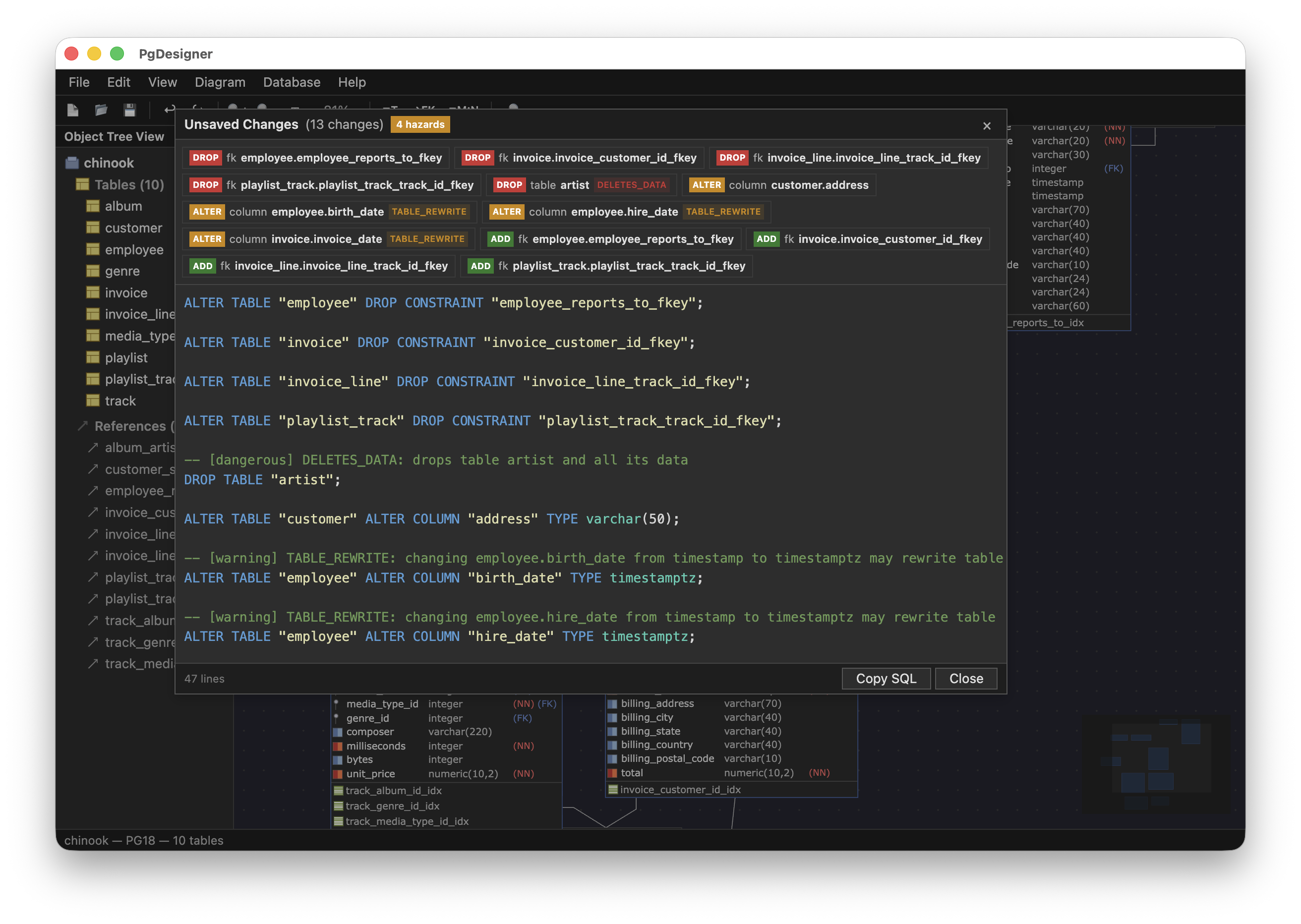
Every generated ALTER is analyzed for operational risk. The engine emits a hazard comment directly before the SQL statement:
DELETES_DATA (dangerous)
Triggered by: DROP TABLE, DROP COLUMN.
-- [dangerous] DELETES_DATA: drops table artist and all its data
DROP TABLE "artist";
Permanent data loss. Requires explicit confirmation.
TABLE_RECREATE (dangerous)
Triggered by: adding, removing, or changing PARTITION BY strategy on an existing table.
This effectively requires rebuilding the entire table — not just an ALTER.
TABLE_REWRITE (warning)
Triggered by: ALTER COLUMN TYPE with incompatible cast.
-- [warning] TABLE_REWRITE: changing employee.birth_date from timestamp to timestamptz may rewrite table
ALTER TABLE "employee" ALTER COLUMN "birth_date" TYPE timestamptz;
PostgreSQL may rewrite every row on disk. On a 10M-row table, this means an exclusive lock for minutes.
BACKFILL_REQUIRED (warning)
Triggered by: ADD COLUMN NOT NULL without DEFAULT or IDENTITY.
Existing rows have no value for the new column — the INSERT will fail.
DETACH_PARTITION (warning)
Triggered by: removing a partition from the partition list.
REATTACH_PARTITION (warning)
Triggered by: partition bounds changed — DETACH then re-ATTACH with new bounds.
Smart features
Compatible cast detection
Not all type changes are dangerous. PgDesigner recognizes safe widenings:
varchar(50)→varchar(255)— safe, no rewriteinteger→bigint— safe, no rewritesmallint→integer— safe, no rewrite
These don’t trigger TABLE_REWRITE.
Semantic rename detection
Renamed an index or foreign key? PgDesigner compares the structural definition — table, columns, method — not just the name. If the structure is identical, it skips the drop+add cycle.
What gets diffed
Tables (including comment and PARTITION BY), columns (type, nullable, default, identity with sequence options, comment, compression, storage), indexes, FK, PK, UNIQUE, CHECK constraints, enum values, and partitions.
Views and functions diff is planned for Phase 2.
CLI usage
pgdesigner diff old.pgd new.pgd
pgdesigner diff -f json old.pgd new.pgd
The diff command outputs ALTER SQL to stdout. Use -f json for machine-readable output in CI pipelines. Exit code 1 if changes are found — useful for drift detection.
UI usage
Press Ctrl+D in the visual editor to see a live diff of your unsaved changes. Every change shows:
- The ALTER SQL statement
- Hazard badge (color-coded: red = dangerous, yellow = warning)
- Affected object path (schema.table.column)
You see the risk before you commit.